
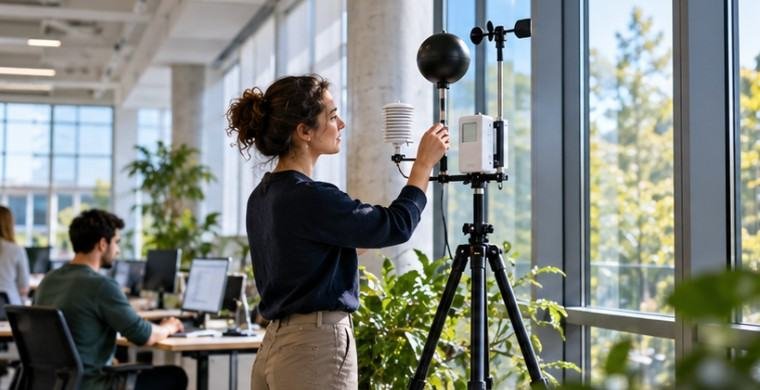
A room can register 72°F and still feel uncomfortably cold to one person and stuffy to another. That apparent contradiction is the first lesson in how to measure thermal comfort in building research: temperature alone is not thermal comfort.
ASHRAE defines thermal comfort around human satisfaction with the thermal environment, meaning researchers must measure both the physical conditions of a space and how occupants actually experience them. Current ASHRAE Standard 55 guidance considers temperature, radiation, humidity, air speed, clothing, and activity together rather than treating a thermostat reading as proof of comfort.
For architects and building researchers, that changes the study from a simple temperature check into a coordinated field investigation.
Thermal Comfort Is a Human Heat-Balance Problem
The human body continuously exchanges heat with its surroundings through convection, radiation, evaporation, and conduction. Whether a person feels warm or cool depends on how effectively those exchanges balance metabolic heat production.
Six variables therefore form the foundation of most thermal comfort studies.
| Variable | What researchers measure or estimate | Typical method |
| Air temperature | Temperature of surrounding air | Calibrated temperature sensor |
| Mean radiant temperature | Thermal influence of nearby surfaces | Globe thermometer or calculated MRT |
| Relative humidity | Moisture content of indoor air | Humidity sensor |
| Air velocity | Air movement around occupants | Hot-wire anemometer |
| Clothing insulation | Resistance provided by clothing | Clo estimate |
| Metabolic rate | Heat generated by activity | Met estimate |
These measurements matter collectively. A person sitting beside a cold exterior window may feel chilly even when room air temperature appears normal because radiant heat loss toward the glass changes the person’s thermal balance.
Similarly, a warmer room may remain comfortable when ceiling fans raise local air velocity.
Measure the Space Where People Actually Experience It

A common research mistake is mounting one temperature sensor on a wall and assuming it represents the entire room.
It rarely does.
The National Institute of Standards and Technology’s thermal comfort research illustrates why spatial measurement matters. In its residential test facility, NIST researchers used an array of sensors distributed through a bedroom rather than relying on a single point. Their setup measured dry-bulb temperature at numerous positions while also monitoring humidity, radiant temperature, and airflow.
That approach can reveal conditions hidden by room averages.
Build a Sensor Grid
For a field study, divide the occupied area into representative zones rather than placing instruments only beside the thermostat.
Include locations near:
- exterior glazing;
- interior walls;
- HVAC supply diffusers;
- doors and entrances;
- perimeter workstations;
- direct solar exposure; and
- central occupied zones.
Measurements at different heights are also valuable because warm air can accumulate above occupants while cooler air remains near the floor.
ASHRAE’s 2023 Standard 55 revisions specifically strengthen consideration of local discomfort, including vertical air-temperature differences between head and ankle levels.
Record More Than Air Temperature
Air Temperature and Humidity
Use calibrated sensors with known accuracy rather than inexpensive consumer thermostats whenever research quality matters.
Record continuously if possible. A ten-minute snapshot can miss afternoon solar gains, morning warm-up periods, HVAC cycling, or changing occupancy.
Relative humidity should be logged simultaneously because it influences evaporative heat loss. However, humidity should not be interpreted independently of temperature and airflow.
Mean Radiant Temperature
Mean radiant temperature, or MRT, represents the combined thermal influence of surrounding surfaces.
Researchers commonly estimate it using a black-globe thermometer. MRT becomes particularly important near large windows, hot roofs, exterior walls, radiant heating systems, and sunlit surfaces.
Ignoring it can produce misleading results: two workstations with identical air temperatures may create very different comfort conditions.
Air Speed
Hot-wire or omnidirectional anemometers can measure low indoor air velocities.
Air movement matters because increased velocity improves convective and evaporative cooling. The U.S. Department of Energy’s climate-responsive building research has examined strategies including fans, operable windows, natural ventilation, mixed-mode systems, and thermal mass when evaluating occupant comfort and environmental performance.
Add the Two Variables Sensors Cannot Measure
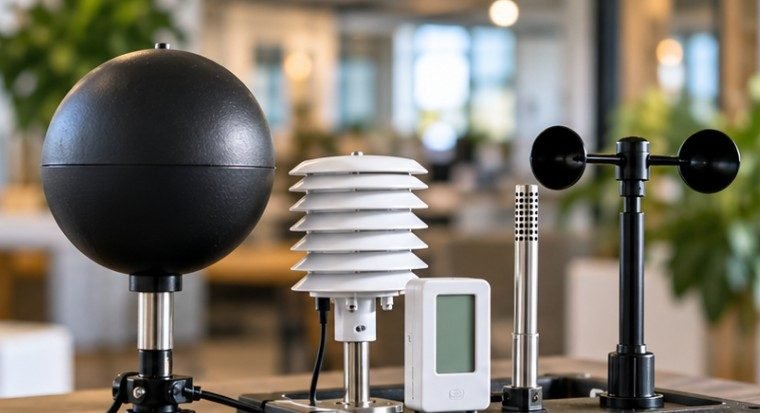
Environmental instruments cannot tell you how much insulation someone’s clothing provides or how much metabolic heat that person generates.
Researchers therefore estimate clothing insulation in clo units and activity in met units.
A seated office worker has a lower metabolic rate than someone performing physical work. A person wearing a jacket also exchanges heat differently from someone wearing lightweight summer clothing.
Record these variables during the survey instead of assuming one value for everyone.
Turn Measurements Into Thermal Comfort Indices
Raw environmental data becomes more useful when analyzed through established comfort models.
PMV and PPD
Predicted Mean Vote, or PMV, predicts the average thermal sensation of a group using a scale running approximately from cold to hot, with neutrality near zero.
Predicted Percentage Dissatisfied, or PPD, estimates the portion of occupants likely to remain thermally dissatisfied.
Researchers can enter air temperature, radiant temperature, humidity, air velocity, clothing, and metabolic rate into tools such as the UC Berkeley Center for the Built Environment Thermal Comfort Tool. The tool supports PMV, PPD, elevated-air-speed analysis, and adaptive comfort calculations.
Adaptive Comfort
PMV is not the best model for every building.
People in naturally ventilated buildings often adapt by opening windows, operating fans, changing clothing, or accepting seasonal temperature variation.
ASHRAE Standard 55 therefore includes an adaptive approach for qualifying occupant-controlled naturally conditioned spaces. The 2023 edition consolidates its main evaluation framework into standard and adaptive methods.
Ask Occupants at the Same Time You Measure Them
Thermal comfort ultimately involves perception, so sensor data should be paired with occupant surveys.
Ask short questions such as:
Thermal sensation: cold, cool, slightly cool, neutral, slightly warm, warm, or hot.
Preference: would you prefer to be warmer, cooler, or unchanged?
Acceptability: is the current thermal environment acceptable?
Time-stamp every response. A survey completed at 2:15 p.m. becomes substantially more useful when it can be matched with environmental measurements recorded at 2:15 p.m.
For broader building investigations, thermal findings can also become part of a post-occupancy evaluation of sustainable building performance, allowing comfort results to be compared with energy use, occupant behavior, and building-system performance.
A Practical Thermal Comfort Field-Test Workflow
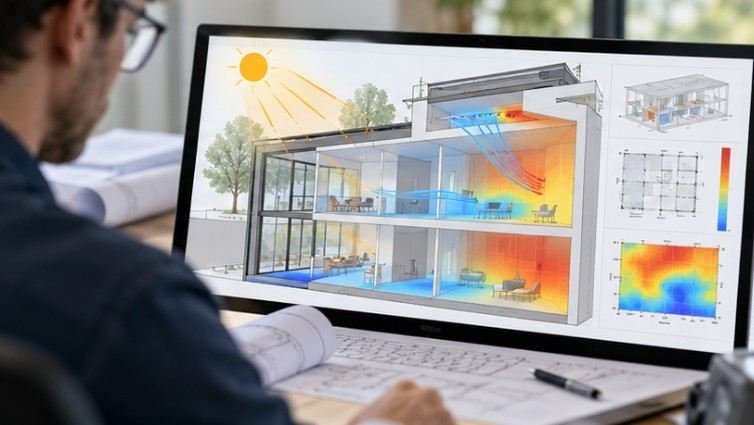
For researchers wondering how to measure thermal comfort in building research without overcomplicating the study, I would use this sequence:
1. Define the Research Question
Decide whether you are investigating general satisfaction, overheating, cold discomfort, HVAC performance, façade effects, natural ventilation, or another specific condition.
2. Select Representative Locations
Map occupied zones and identify perimeter, interior, sunny, shaded, mechanically conditioned, and naturally ventilated locations.
3. Calibrate and Deploy Instruments
Measure air temperature, humidity, air speed, and radiant conditions at appropriate occupant locations and heights.
4. Record Context
Document weather, time, occupancy, window position, fan operation, HVAC mode, solar exposure, clothing, and activity.
5. Conduct Simultaneous Surveys
Collect thermal sensation, preference, and acceptability votes while environmental measurements are being taken.
6. Calculate Comfort Indices
Use PMV/PPD for appropriate mechanically conditioned conditions or the adaptive model where its applicability requirements are met.
7. Compare Patterns, Not Just Averages
Look for recurring discomfort near façades, diffusers, floors, windows, or particular times of day.
The CDC/NIOSH guidance for office environments similarly emphasizes managing temperature, humidity, airflow, and other aspects of the physical environment rather than treating indoor comfort as a single-variable problem.
Where Thermal Comfort Studies Commonly Go Wrong
Comfort models predict population responses; they do not guarantee that every occupant will be comfortable. Age, physiology, expectations, adaptation, personal control, clothing choice, solar exposure, and individual preferences all influence perception.
Another misconception is that maintaining one narrow thermostat setting automatically provides better comfort. Berkeley’s Center for the Built Environment notes that broader temperature ranges can sometimes maintain acceptable comfort while reducing unnecessary energy demand, particularly when researchers properly account for air movement and adaptive behavior.
Researchers should also distinguish ordinary thermal comfort from occupational heat stress. Extremely hot working environments require health and safety assessment rather than routine comfort analysis. NIOSH heat-stress recommendations address those higher-risk conditions.
Frequently Asked Questions
1. What instruments are needed to measure thermal comfort?
Most field studies require calibrated temperature and humidity sensors, an air-velocity meter, and a globe thermometer or another method for estimating mean radiant temperature.
2. What is the best thermal comfort index?
There is no universal best model. PMV/PPD suits many conditioned spaces, while adaptive comfort methods are more appropriate for qualifying naturally conditioned environments.
3. How long should thermal comfort measurements last?
It depends on the question. Spot measurements can diagnose immediate conditions, but multi-hour, daily, seasonal, or long-term monitoring better captures HVAC cycles, weather, and occupancy changes.
4. Why are occupant surveys necessary?
Sensors describe physical conditions; surveys reveal whether people actually find those conditions comfortable, acceptable, warmer than preferred, or cooler than preferred.
Designing Research Around People, Not Thermostats
The most useful lesson from how to measure thermal comfort in building research is that there is no magic temperature that proves a building works.
A strong study connects environmental sensors, occupant location, clothing, activity, subjective votes, weather, and an appropriate comfort model. It also searches for variation rather than hiding it inside room-wide averages.
If a project records only thermostat temperature, it measures the HVAC system’s output. If it combines physical measurements with human response, it begins measuring what architects actually need to understand: whether people are comfortable in the spaces they designed.