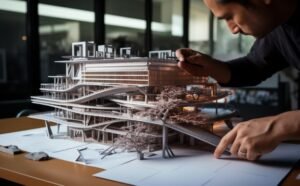
Walls, roofs, and foundations influence roughly 28% of building energy use in the United States, according to the U.S. Department of Energy. Yet energy efficiency tells only part of the climate story. A highly efficient building can still overheat during a blackout, flood during an extreme storm, or carry a substantial carbon burden in its concrete and steel.
That is why architecture research that responds to climate is becoming broader and more demanding. Researchers are studying not only how buildings consume energy, but how they perform under heat, drought, wildfire smoke, flooding, shifting rainfall patterns, material constraints, and future weather conditions.
The central question has changed from “How sustainable is this building?” to something harder: “Will this building still perform well as its climate changes?”
Climate-Responsive Research Starts With Place
Climate-responsive architecture is not a collection of universal green features. A strategy that works in Phoenix may be poorly suited to Seattle, Miami, or Minneapolis.
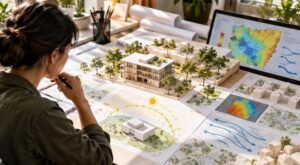
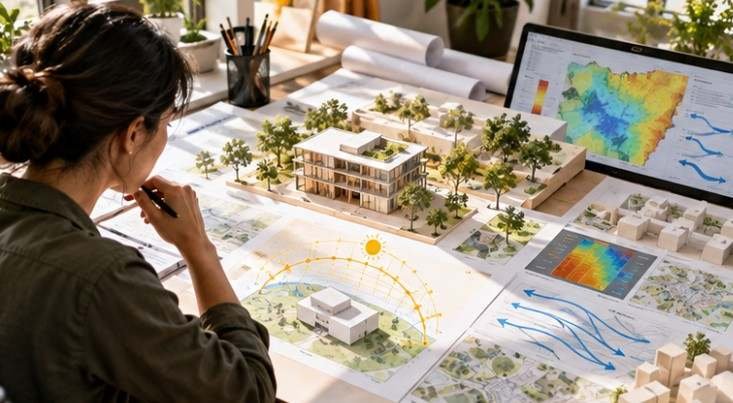
Researchers therefore begin with environmental conditions: temperature ranges, solar exposure, humidity, wind, precipitation, heating and cooling seasons, wildfire risk, flooding, and increasingly the projected future climate.
The Department of Energy’s climate-specific building guidance recognizes this regional reality by connecting construction assemblies to IECC climate zones and examining thermal efficiency and condensation control.
The important research move is to treat climate data as a design input rather than background information.
A researcher studying a school in Arizona, for example, might test shade depth, roof reflectance, glazing ratios, thermal mass, nighttime cooling, and emergency overheating. A project in coastal Florida may place greater emphasis on moisture, wind, flooding, drainage, and passive survivability during power failures.
Passive Design Is Being Tested More Precisely
Passive architecture predates mechanical air conditioning, but contemporary research gives it sophisticated analytical tools.
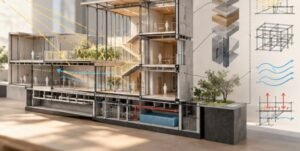
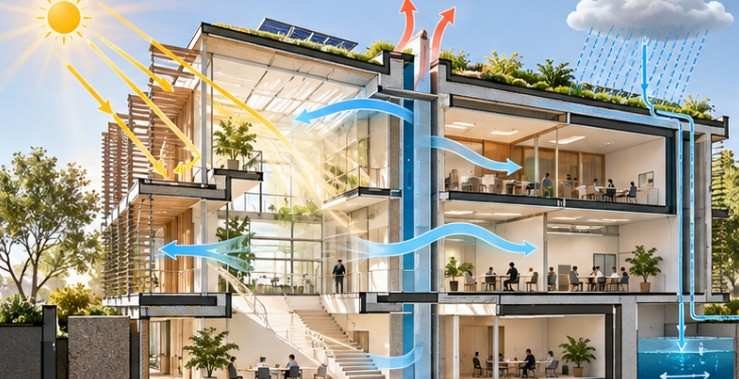
Researchers can simulate orientation, glazing, insulation, natural ventilation, daylight, shading, roof geometry, thermal mass, and surface reflectivity before construction. Instead of assuming that “more glass” or “more insulation” is automatically better, models reveal how those choices interact with actual climate conditions.
The Department of Energy identifies orientation, fenestration, shading, daylight, ventilation, and envelope design among the core considerations for zero-energy buildings. A good research question might therefore be:
How many comfortable hours can the building maintain without mechanical cooling?
That question becomes especially valuable during heat waves or grid failures. Researchers can compare indoor temperatures under normal operation with temperatures during a simulated power outage, revealing whether passive measures offer genuine resilience rather than simply reducing an annual energy model.
Materials Have Become a Climate Research Question
Operational energy once dominated sustainable-design discussions. Now embodied carbon—the emissions associated with extracting, manufacturing, transporting, installing, replacing, and eventually disposing of materials—receives far more attention.
Mass timber is one prominent research area.
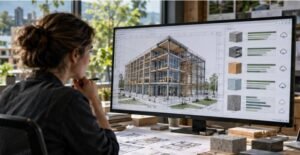
A U.S. Forest Service life-cycle study comparing cross-laminated timber with reinforced concrete found significant embodied-carbon reductions for the timber alternative, although outcomes depend on system boundaries, transportation, fire-protection materials, forestry conditions, and assumptions about stored biogenic carbon.
That qualification matters. “Wood equals low carbon” is too simplistic.
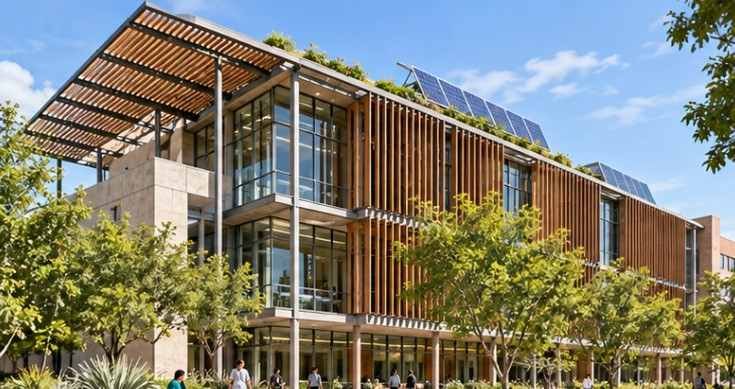
Researchers should compare complete assemblies through whole-building life-cycle assessment rather than judging a material by reputation alone. Concrete mixes with lower cement content, recycled steel, salvaged components, bio-based insulation, locally sourced materials, and material-efficient structural systems may all change the result.
The Research Agenda Now Includes Future Hazards
One of the largest shifts in architecture research that responds to climate is the move from historical conditions toward future conditions.
Building codes traditionally depend heavily on observed historical hazards. Climate change complicates that assumption because heat, precipitation, coastal flooding, wildfire exposure, and other risks may not remain statistically stationary over a building’s life.
A 2026 National Institute of Standards and Technology report identified future hazards, forward-looking building standards, material durability, structural-capacity degradation, and adaptive building design as important research needs for forward-looking codes and standards.
For architecture researchers, that suggests testing several scenarios rather than one “typical” weather year.
| Research question | What to test | Useful performance measure |
| Can occupants stay comfortable? | Heat waves, outages, seasonal extremes | Indoor temperature, comfort hours |
| Can the envelope cope? | Heat, moisture, wind, solar exposure | Heat flow, condensation risk |
| Is the structure adaptable? | Flood, wind, future hazards | Damage and recovery time |
| Is carbon being reduced? | Material and energy scenarios | Whole-life carbon |
| Does the site improve resilience? | Rainfall and extreme heat | Runoff, shade, surface temperature |
Landscape and Buildings Must Be Studied Together
Climate-responsive research increasingly crosses the property line.
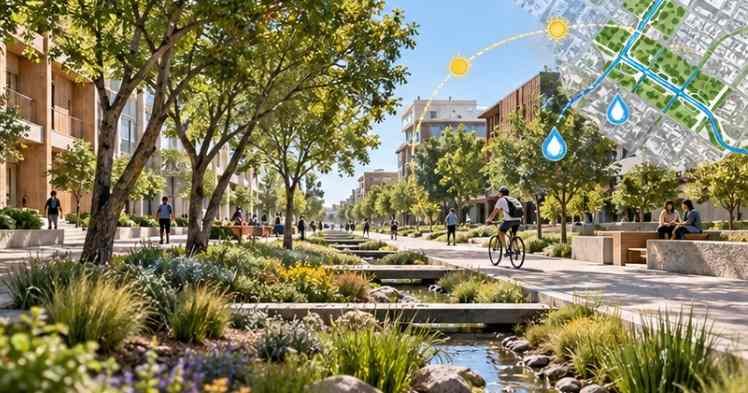
Urban heat, stormwater, shade, biodiversity, and public health are shaped as much by landscapes and streets as by individual buildings. Harvard Graduate School of Design describes climate-focused landscape research in relation to heat, aridity, wildfires, flooding, sea-level rise, and carbon reduction.
The EPA similarly notes that trees, vegetation, and green roofs can help cool urban environments through shading and evapotranspiration.
This means a research project should not stop at insulation values and HVAC efficiency. It may also examine tree canopy, outdoor thermal comfort, permeable surfaces, water retention, shaded pedestrian routes, ecological connectivity, and neighborhood-scale heat exposure.
A Five-Step Method for Climate-Responsive Architecture Research
A useful study can be structured around five stages.
1. Establish the climatic baseline
Collect temperature, humidity, wind, solar radiation, precipitation, and hazard data. Identify the site’s climate zone, but avoid treating the zone as the entire analysis.
2. Define measurable risks
Translate climate information into design questions. Instead of simply listing “extreme heat,” ask how many hours indoor temperatures exceed an agreed threshold during a multi-day outage.
3. Compare design alternatives
Model different orientations, envelopes, shading systems, materials, ventilation strategies, landscape treatments, and mechanical systems. A baseline option makes the improvement measurable.
4. Test future scenarios
Where reliable projections are available, repeat the analysis under hotter or wetter future conditions. Test multiple scenarios rather than pretending one forecast represents certainty.
5. Measure the finished building
Simulation is a hypothesis, not proof. Researchers should compare predicted results against energy bills, indoor temperatures, humidity, air quality, and occupant experience.
A structured post-occupancy evaluation of sustainable building performance can expose gaps between design assumptions and actual operation. Existing buildings can also be investigated through net-zero energy building retrofitting methodologies rather than assuming demolition and replacement are automatically the greener solution.
Climate Justice Changes What Counts as Good Performance
Climate performance cannot be evaluated solely through kilowatt-hours.
Heat, flooding, air pollution, displacement, and high energy costs do not affect communities equally. The American Institute of Architects consequently links climate action with health, resilience, environmental justice, economic conditions, and decarbonization across building, neighborhood, and regional scales.
That adds another research question: who actually benefits?
A cooling strategy that works only when residents can afford continuous air conditioning is less resilient than one combining efficient systems with shade, insulation, passive cooling, and safe backup conditions.
What Climate-Responsive Research Can Get Wrong
Simulation software can create false precision.
Weather files may represent historical averages rather than emerging extremes. Occupancy assumptions may be unrealistic. Natural ventilation may look excellent in a model but become unusable because of outdoor smoke, noise, humidity, security concerns, or poor air quality.
Low-carbon materials also involve tradeoffs involving sourcing, durability, fire protection, transportation, and end-of-life treatment.
The strongest studies therefore report assumptions clearly, test sensitivity, compare alternatives, and verify modeled performance after occupancy.
FAQs
1. What is climate-responsive architecture research?
It studies how buildings and urban environments can respond to local climate, reduce emissions, maintain occupant comfort, and withstand changing environmental conditions.
2. Which climate factors should architects research first?
Temperature, humidity, solar exposure, wind, precipitation, flooding, wildfire risk, and future climate projections are useful starting points.
3. Does climate-responsive design always require expensive technology?
No. Orientation, shading, insulation, natural ventilation, compact form, daylight control, vegetation, and material efficiency can provide significant benefits before advanced systems are considered.
4. Why is post-occupancy research important?
It shows whether predicted energy use, comfort, ventilation, and resilience actually occur once real occupants and operating conditions replace computer assumptions.
Where the Research Needs to Lead
The most valuable climate research does not produce another list of sustainable features. It tests whether architecture can continue protecting people as environmental conditions become less predictable.
That means studying carbon and comfort together, testing future hazards rather than relying entirely on historical averages, questioning material claims through life-cycle assessment, and returning to completed buildings to see what actually worked. Architecture research that responds to climate ultimately succeeds when research changes design decisions—not merely when it produces better simulations. The building itself must become the evidence.