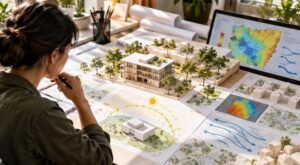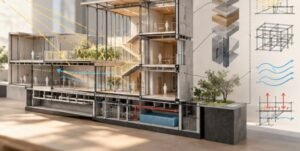

Small-city redevelopment can be more consequential than a headline-grabbing megaproject. In a smaller community, one empty mill, school, bank, or industrial plant can weaken an entire district. At the same time, one successful conversion can catalyze housing, jobs, tourism, and downtown activity. I see adaptive reuse as especially powerful because it links local economic development with historic preservation and environmental sustainability.
Which US Adaptive Reuse Projects Offer the Best Lessons?
Congdon Yards, High Point, North Carolina
Congdon Yards transformed the former Adams-Millis Hosiery Mill complex into a mixed-use hub with offices, business incubator space, event venues, dining, coffee, public gathering areas, and maker facilities. The Congdon Foundation says it invested more than $40 million in the project, which opened as a community hub in 2021.
What makes it important is its role as an anchor. Instead of restoring one old factory for a single tenant, the project created several reasons to work, meet, eat, create, and spend time downtown. For smaller US cities, that diversified use can strengthen foot traffic and encourage surrounding investment.
Ambler Boiler House, Ambler, Pennsylvania
The Ambler Boiler House shows how historic building reuse can address environmental cleanup and commercial redevelopment at the same time. The abandoned industrial plant was transformed from a brownfield into roughly 42,000 square feet of multi-tenant office space. The project preserved important industrial elements, relied on a public-private partnership, and achieved LEED Platinum certification.
Its location near regional rail also demonstrates the value of combining adaptive reuse with transit-oriented development.
Carlton Lofts, Cloquet, Minnesota

Cloquet converted its historic high school into Carlton Lofts, a 57-unit residential development while retaining significant spaces such as the original gymnasium and auditorium. It is a strong example of adaptive reuse housing because it addresses two common small-city problems: a vacant institutional building and demand for workforce housing.
Historic tax credits and housing finance helped make the project workable, illustrating why creative adaptive reuse financing often matters in smaller real estate markets.
Bank Lofts, Richfield Springs, New York
A long-vacant 19th-century bank in Richfield Springs became the Bank Lofts, a 14,787-square-foot mixed-use development containing nine apartments and street-level commercial space. The project also incorporates Passive House strategies, all-electric systems, solar generation, and EV charging.
I like this example because it joins vacant building reuse, housing, Main Street activation, and energy efficiency. Mixed-use redevelopment can be particularly valuable in a small downtown where retail demand alone may not justify a major rehabilitation.
Rushville, Indiana
Rushville acquired the former Phoenix Masonic Lodge and planned its reuse for several community functions, including city government offices, Ivy Tech space, and restored theater use.
The project shows why flexibility matters. Historic buildings do not always need to return to one original purpose. Civic, educational, cultural, and entertainment uses can work together to keep a landmark productive.
What Can US Cities Learn From International Adaptive Reuse?

A US-centered strategy can still borrow good ideas from other countries.
Heritance Tea Factory in Sri Lanka converted a former tea-processing facility into a hotel while retaining steel structures, timber floors, machinery, and much of its industrial character. Spaces once associated with tea processing became guest rooms and hospitality areas.
For American mill towns and former manufacturing communities, it shows how industrial heritage can become part of the visitor experience rather than something hidden during renovation. Heritage tourism can preserve local identity while generating new economic activity.
Alembic Industrial Heritage in Vadodara, India, took a different approach. A former manufacturing building used over time for products including penicillin and alcohol became a cultural destination with a museum, art studios, exhibition space, a library, an AV room, and a café.
That model can inspire smaller US cities whose older factories may work better as cultural or creative hubs than conventional offices.
Kandadu, near Pondicherry, offers a preservation lesson at a smaller scale. The late-19th-century mansion was carefully restored after years of neglect and now functions as a residence, workshop, and creative environment. Its historic masonry, deep veranda, landscape, craftsmanship, and signs of age became assets rather than flaws.
The lesson is simple: historic preservation does not have to make an old building look new.
Why Does Adaptive Reuse Have an Outsized Effect in Small Cities?
The central lesson from adaptive reuse case studies in small cities is scale. In a large metro, one restored property can disappear within an enormous real estate market. In a small downtown, one successful project can add a meaningful share of new housing, workspace, visitors, or foot traffic.
Successful projects usually align a realistic new use with financing, regulatory flexibility, and a broader downtown revitalization plan. Historic tax credits, grants, public-private partnerships, zoning changes, and infrastructure investment may determine whether a promising concept actually gets built.
Environmental sustainability adds another advantage by extending the life of existing structures and avoiding unnecessary demolition. But a viable project must still answer a real community need.
How Should Small Cities Choose Buildings for Adaptive Reuse?

I would start with location, structural condition, ownership, code requirements, local demand, and available incentives. Architectural character matters, but the new use has to make economic sense.
Schools, mills, banks, warehouses, mansions, grain facilities, and industrial plants can all become candidates for small-city redevelopment. The strongest opportunities are buildings that can function as downtown anchors while solving a present-day need.
An old school may address a housing shortage. A former factory might become creative workspace. A historic bank can support apartments and commercial activity. An industrial landmark might become a tourism or cultural destination.
Frequently Asked Questions (FAQs)
1. What are the best adaptive reuse case studies in small cities?
Strong US examples include Congdon Yards, Ambler Boiler House, Carlton Lofts, Bank Lofts, and Rushville’s Phoenix Masonic Lodge. International examples such as Heritance Tea Factory, Alembic Industrial Heritage, and Kandadu provide additional ideas that American communities can adapt to local conditions.
2. Can adaptive reuse help revitalize a small downtown?
Yes. Reuse can return vacant properties to productive use, add residents and workers, increase foot traffic, support nearby businesses, preserve local identity, and encourage additional private investment.
3. Is adaptive reuse cheaper than new construction?
Not always. Reusing an existing structure can reduce demolition and replacement needs, but remediation, accessibility upgrades, structural repairs, historic requirements, and outdated mechanical systems can raise costs. Adaptive reuse financing and historic tax credits often help close that gap.
What Small Cities Should Take Away
For me, the best reuse projects prove that preservation works best when it solves a current economic or community problem. The goal is not simply to save an old building. It is to give that building a durable new purpose while considering broader planning priorities such as urban heat mitigation.
For US towns looking at an empty mill, school, bank, factory, or civic landmark, the key question is whether a smart new use can strengthen the surrounding district while preserving what makes the place distinctive.