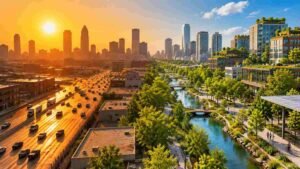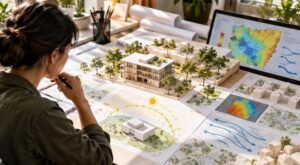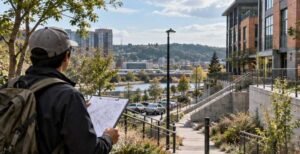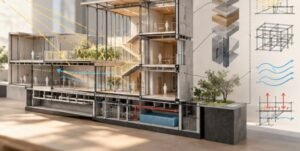
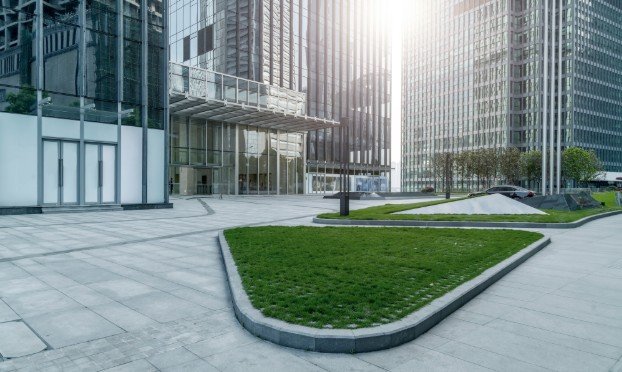
I have always found urban heat troubling because it is not distributed evenly. A shaded neighbourhood can feel dramatically cooler than a nearby district covered by asphalt, dark roofs, and closely packed buildings.
The best urban heat mitigation case studies therefore do more than highlight attractive parks or innovative materials. They show how planning decisions influence air temperature, surface temperature, public health, energy demand, and everyday comfort.
Cities are testing combinations of trees, reflective surfaces, restored waterways, ventilation corridors, cool roofs, and heat-health planning. These examples reveal what works, where limitations appear, and why accurate measurement matters.
How Urban Cooling Is Measured
Surface temperature is useful for comparing roofs, roads, pavements, and walls, but it does not tell the complete story. A reflective pavement may become much cooler in sunlight without producing an equally large reduction in the surrounding air temperature.
Air temperature shows whether a project cools the wider neighbourhood. Thermal comfort goes further by considering shade, wind, humidity, and radiant heat at pedestrian level. Indoor temperature and energy use are also important because cool roofs, trees, and improved building envelopes can reduce overheating and demand for mechanical cooling.
Medellín: Building Connected Green Corridors
Medellín created green corridors along roads and waterways to increase shade, restore vegetation, and reconnect ecological areas. Trees and smaller plants block solar radiation while releasing moisture through evapotranspiration.
The strength of this approach is continuity. An isolated park cools a limited area, while connected greenery can form a network of shaded walking routes. It can also support biodiversity, improve air quality, and make public spaces more comfortable.
The challenge is maintenance. Trees require suitable soil, irrigation, pruning, and replacement. Cities following this model must select species that can survive local heat, rainfall patterns, and water constraints.
Seoul: Restoring the Cheonggyecheon Stream
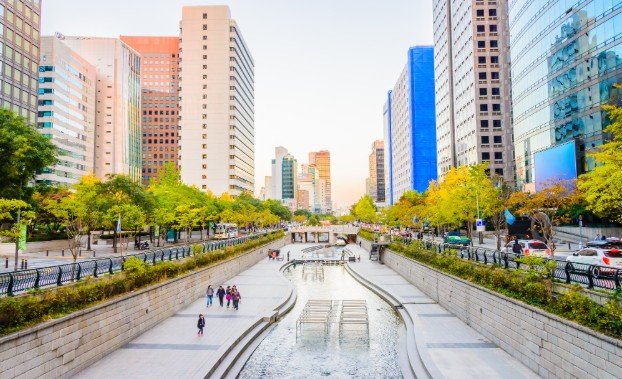
Seoul removed an elevated roadway and restored the Cheonggyecheon stream as a linear public space. The project replaced heat-absorbing infrastructure with water, vegetation, shade, pedestrian areas, and improved airflow.
This example shows how cooling can be combined with transport reform and public-space renewal. The corridor provides recreation and habitat while reducing the dominance of concrete.
However, water is not automatically effective everywhere. Cooling performance depends on airflow, humidity, shade, water quality, and project scale. Large redevelopment schemes also require careful funding and equity planning so nearby communities benefit without being displaced.
Phoenix: Testing Reflective Pavements
Phoenix tested reflective coatings that absorb less solar energy than conventional dark asphalt. Treated streets recorded lower daytime surface temperatures, demonstrating the importance of material selection.
The trial also revealed a trade-off. Brighter pavement may reflect more solar radiation towards pedestrians during certain periods. Measuring only surface temperature can therefore create an incomplete impression of comfort.
Reflective pavement works better when combined with trees, shade structures, suitable street orientation, and pedestrian-level monitoring. Local trials should come before widespread adoption because climate, traffic, glare, durability, and maintenance can influence performance.
Guangzhou: Protecting Ventilation Corridors
Guangzhou has explored ventilation corridors that preserve routes for cooler air to travel through dense districts. The strategy connects waterways, wetlands, streets, green spaces, and lower-density development patterns.
Building placement is central to the approach. Closely packed towers can block breezes and trap heat, while carefully positioned buildings can support natural airflow. Rooftop planting, vertical greenery, lighter exterior surfaces, and climate-responsive street layouts provide additional cooling.
This example demonstrates why heat reduction should begin during the planning stage. Creating an airflow route after a neighbourhood is fully developed is far more difficult than protecting it through zoning, building-height controls, and open-space requirements.
Chicago: Upgrading Alleys and Surfaces
Chicago’s green alley projects show how overlooked service spaces can support heat reduction and stormwater management. Lighter paving, permeable surfaces, recycled materials, and improved drainage can help alleys absorb less heat and manage rainfall more effectively.
The approach is practical because it upgrades existing infrastructure without requiring a major new park. It can also be repeated across numerous neighbourhoods.
Its limitation is scale. One renovated alley will not cool an entire district. Noticeable results require coordinated improvements across streets, roofs, parking areas, school grounds, public buildings, and pedestrian routes.
Ahmedabad: Connecting Cool Roofs and Public Health
Ahmedabad’s heat-response measures combine physical cooling with public-health preparation. Cool roofs, heat alerts, community communication, and coordination between agencies help protect residents at both building and city levels.
Reflective roofs can lower roof temperatures and reduce indoor heat exposure, especially in lightweight buildings that become dangerously hot. They are also relatively affordable compared with major infrastructure projects.
Nevertheless, coatings need correct application and periodic renewal. Lessons from waterfront redevelopment case studies also show that effective programmes must reach tenants, low-income communities, schools, care facilities, and informal neighbourhoods rather than serving only property owners who can afford improvements.
Shared Lessons for Cooler Cities
Successful projects rarely depend on one intervention. Trees offer shade but need water and care. Reflective surfaces reduce heat absorption but may increase glare or radiant exposure. Water features can improve comfort but require reliable supplies and ecological management. Ventilation routes support airflow but must be protected through long-term planning.
Prioritise Vulnerable Neighbourhoods
Heat maps should be combined with information about housing quality, age, health risk, income, outdoor work, tree cover, and access to cooling. This prevents investment from being concentrated only in wealthy or highly visible districts.
Measure More Than Surface Heat
Monitoring should include air temperature, nighttime conditions, pedestrian comfort, indoor heat, energy demand, and health outcomes. These indicators provide a more realistic picture of whether residents actually benefit.
Budget for Long-Term Maintenance
Plant survival, irrigation, coating durability, drainage, cleaning, and replacement costs should be considered before construction begins. A project that cannot be maintained may lose its cooling value quickly.
Create Connected Cooling Networks
The most effective plans connect parks, waterways, roofs, streets, buildings, and shaded walking routes. This creates a wider cooling system rather than isolated pockets of relief.
Frequently Asked Questions
1. What can planners learn from urban heat mitigation case studies?
They can compare how climate, urban form, project scale, budgets, and maintenance influence results. They also show why physical improvements should be supported by public-health planning and continuous monitoring.
2. Which measure delivers the fastest cooling benefit?
Shade structures, reflective roofs, and surface coatings can usually be installed faster than mature tree canopy. Trees take longer to develop but can provide shade, biodiversity, cleaner air, and stormwater benefits.
3. Can planting more trees solve urban heat alone?
No. Trees are valuable, but results also depend on building design, surface materials, airflow, water management, roof performance, and access to shaded public spaces.
4. Why does heat equity matter?
The hottest neighbourhoods often have fewer trees, poorer-quality housing, more paved land, and less access to cooling. Investment should therefore prioritise communities experiencing the greatest exposure and health risks.
Final Perspective
I believe the clearest lesson from these projects is that urban heat cannot be solved with one product or a single landmark development. Effective cooling comes from combining vegetation, shade, reflective materials, water-sensitive design, natural airflow, improved buildings, and emergency planning.
When I evaluate urban heat mitigation case studies, I look for measurable outcomes, realistic maintenance plans, community access, and evidence that an intervention improves daily life. Cities that treat cooling as a connected public system will be better prepared for rising temperatures while creating healthier, safer, and more welcoming neighbourhoods.