

A material can look sustainable at the factory gate and perform poorly across a building’s full life. I use life cycle assessment methods for building materials to expose that gap before specifications become expensive commitments. The method tracks resources, emissions, waste, maintenance, replacement, and disposal within a defined boundary.
The real value is not one carbon number. It is a fair comparison based on the same function, lifespan, geography, and calculation rules.
How Life Cycle Assessment Methods for Building Materials Work
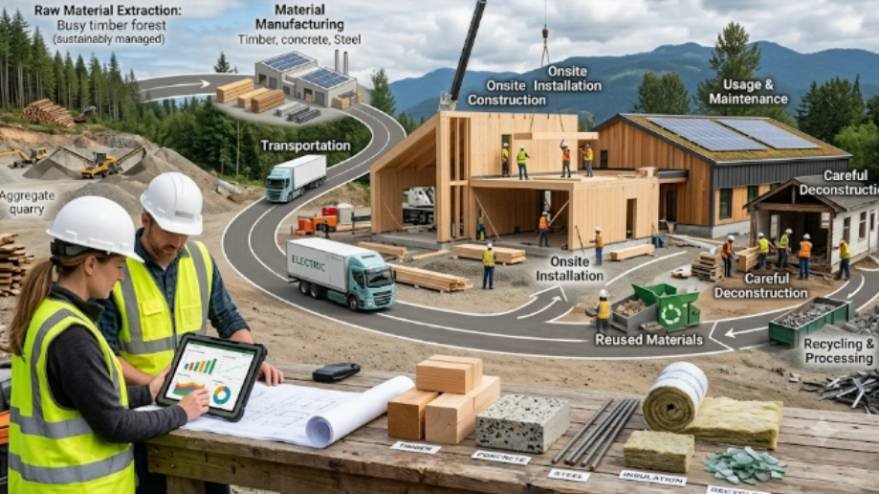
ISO 14040 establishes LCA principles and its overall framework. ISO 14044 provides requirements for conducting and reporting an assessment. Together, they organize LCA into four connected phases.
The Four ISO LCA Phases
Goal and scope definition establishes the purpose, audience, functional unit, assumptions, and system boundary. Life Cycle Inventory, often shortened to LCI, records material, energy, transportation, emissions, and waste flows.
Life Cycle Impact Assessment converts those flows into environmental indicators. These can include climate change, acidification, eutrophication, smog formation, ozone depletion, and human-health effects.
Interpretation examines environmental hotspots, data uncertainty, consistency, and whether the results answer the original question.
I treat these phases as a connected loop rather than a fixed sequence. A data gap found during interpretation may require a revised inventory or a narrower environmental claim.
Functional Units Make Comparisons Fair
A functional unit describes the service being compared. One pound of insulation and one pound of concrete perform different jobs, so comparing their impacts by weight would not support a useful design choice.
For flooring, I may compare one square foot of finished surface over 60 years. For insulation, I include area, thermal resistance, and service life.
An Environmental Product Declaration may report impacts per kilogram, cubic meter, square meter, or another declared unit. That declared unit is not always the functional unit needed for a building decision.
Choose the System Boundary Before Comparing Materials

The most damaging mistake I see is choosing a database first and defining the boundary later. Life cycle assessment methods for building materials only support credible decisions when every option covers equivalent life-cycle stages.
Cradle-to-Gate and Cradle-to-Site
Cradle-to-gate covers raw material supply, upstream transportation, and manufacturing. In EN terminology, these processes fall under Modules A1–A3.
This limited scope works well for early product screening. It can reveal whether cement content, manufacturing energy, recycled inputs, or other production factors drive a product’s upfront impact.
Cradle-to-site adds transportation from the factory to the construction project, identified as Module A4. It matters when products differ in weight, shipping distance, or transportation mode.
A regional material with slightly higher production emissions may outperform an imported alternative once delivery is included.
Cradle-to-Grave and Cradle-to-Cradle
Cradle-to-grave continues through construction, use, maintenance, replacement, demolition, waste processing, and final disposal. I prefer this boundary when products have different lifespans or maintenance requirements.
Cradle-to-cradle also considers potential reuse, recycling, or energy recovery beyond the assessed system. EN reporting places these potential benefits and loads in Module D.
Module D should remain separate from Modules A–C. Future recycling and recovery depend on collection systems, technology, demand, contamination, and dismantling practices that may change.
This broader perspective links LCA with circular design principles for the built environment, including adaptability, reversible connections, disassembly, material recovery, and longer component life.
Understanding EN 15978 and EN 15804 Modules
EN 15978 structures building-level environmental assessment, while EN 15804 provides core rules for construction-product EPDs. Their shared modular approach makes system boundaries easier to identify:
- A1–A3: raw materials, transportation to manufacturing, and production
- A4–A5: delivery to the site and construction or installation
- B1–B7: use, maintenance, repair, replacement, refurbishment, energy, and water
- C1–C4: deconstruction, transportation, waste processing, and disposal
- D: potential benefits and loads beyond the system boundary
Modern EN 15804+A2 EPDs may report more than A1–A3. For buildings in warm, moisture-heavy regions, passive cooling strategies for hot and humid climates can reduce Module B6 operational energy demand and significantly improve whole-building life-cycle results.
Depending on the product and applicable rules, they can include end-of-life modules and Module D.
I never assume two EPDs cover identical stages. I examine their module tables before comparing any results.
Choosing Life Cycle Assessment Methods for Building Materials

LCIA methodologies translate inventory flows into understandable environmental indicators. The right method depends on the project’s geography, reporting rules, available datasets, certification requirements, and environmental priorities.
TRACI for US Building Assessments
The US Environmental Protection Agency developed TRACI to provide characterization factors for Life Cycle Impact Assessment.
TRACI addresses categories such as global warming, acidification, eutrophication, smog formation, ozone depletion, ecotoxicity, and human-health effects. This makes it a practical choice for many North American building studies.
However, using TRACI does not automatically make an assessment accurate. The datasets, functional unit, system boundary, and service-life assumptions still require careful review.
CML and ReCiPe for Wider Impact Analysis
CML is a long-established midpoint methodology found in many international LCA datasets. Older datasets prepared under EN 15804+A1 commonly use CML indicators.
Newer EN 15804+A2 datasets may apply updated Environmental Footprint-based characterization rules. I therefore avoid treating all European environmental data as methodologically identical.
ReCiPe provides detailed midpoint indicators and broader endpoint damage categories. Midpoint indicators reveal specific issues such as climate change or toxicity. Endpoint indicators group results into wider effects on human health, ecosystems, and resources.
I prefer midpoint results for technical design decisions because they expose trade-offs. Endpoint scores can support communication, but aggregation introduces additional modeling choices.
A Practical Material LCA Workflow
My workflow for life cycle assessment methods for building materials begins with the decision, not the software.
I first define the question, functional unit, study period, geographical location, system boundary, and required indicators. I then gather material quantities and select datasets that follow compatible rules.
Use Comparable, Verified Data
A manufacturer-specific EPD can improve accuracy, but it is not automatically comparable with another EPD.
Before comparing products, check:
- Product Category Rules
- Declared and functional units
- Publication and validity dates
- Geographic and technological relevance
- Electricity and transportation assumptions
- Allocation procedures
- Third-party verification
- Life-cycle module coverage
Generic data remains useful during concept design when manufacturers are unknown. As procurement becomes clearer, I replace generic values with product-specific data and record every substitution.
Match the Tool to the Decision
One Click LCA supports whole-building assessment, extensive environmental datasets, and integrations such as Revit and Rhino. TallyLCA calculates building-material impacts within Revit.
EC3 is a free, open-access tool focused on embodied-carbon specification and procurement using digitized EPD information. Athena’s Impact Estimator supports building assembly and whole-building modeling with North American inventory data.
I use EC3 when comparing products during procurement. I choose a whole-building platform when replacements, operational impacts, and end-of-life scenarios could affect the result.
Worked Example: When Higher Upfront Carbon Wins
Consider two hypothetical floor finishes covering 1,000 square feet over a 60-year study period.
Finish A reports 2.0 kilograms of CO2e per square foot for Modules A1–A3. It lasts 15 years, requiring four installations. Its replacement-adjusted product-stage emissions total 8,000 kilograms.
Finish B reports 3.0 kilograms of CO2e per square foot but lasts 30 years. Two installations create 6,000 kilograms.
Finish B has a 50% higher footprint during the first installation. Yet its replacement-adjusted product-stage impact is 25% lower over 60 years.
Transportation, installation waste, maintenance, and disposal could widen or reverse that result. The example shows why life cycle assessment methods for building materials must compare equal service rather than equal purchase quantities.
Common LCA Mistakes That Distort Results
Even recognized life cycle assessment methods for building materials can produce a false winner when their inputs are misaligned.
Do not compare EPD values with different units, Product Category Rules, or life-cycle modules. Never place an A1–A3 value beside an A1–C4 total and present them as equivalent.
Service-life assumptions deserve equal scrutiny. A lifespan copied from a generic database may not reflect the project’s climate, traffic, moisture exposure, installation quality, or maintenance schedule.
Treat Module D as a potential future benefit rather than guaranteed recycling. Also look beyond global warming potential when water use, toxicity, resource depletion, or air pollution could shift impacts elsewhere.
Frequently Asked Questions
1. What are the best life cycle assessment methods for building materials?
TRACI often suits US projects, but the required standard, dataset, location, and reporting objective should determine the final method.
2. What is the difference between LCA and an EPD?
LCA is the assessment process, while an EPD is a standardized and usually verified declaration reporting selected product-level LCA results.
3. Which LCA boundary should architects use?
Use A1–A3 for early screening, then expand toward cradle-to-grave when maintenance, replacement, durability, and disposal may affect the decision.
4. Can life cycle assessment methods for building materials support circular design?
Yes. They can test whether reuse, adaptability, disassembly, recycling, and longer service life reduce impacts across the assessed modules.
The Carbon Numbers Do Not Get the Last Word
I trust life cycle assessment methods for building materials when the assumptions remain as visible as the results. A polished dashboard cannot rescue mismatched units, missing modules, or unrealistic replacement cycles.
Start with one decision and one functional unit. Compare two materials across the same boundary, test their service lives, and document uncertainty.
That disciplined first comparison will teach you more than a massive model built on shaky inputs.