I have always found architecture most exciting when an ambitious digital idea becomes a physical structure. For decades, however, that transition required designers to simplify complex geometry so conventional tools, molds and construction crews could produce it. Architectural robotics is beginning to remove that limitation.
Industrial robotic arms can now cut timber, deposit concrete, bend metal, assemble bricks, carve foam and position customized building components. Instead of functioning only as repetitive factory machines, robots are becoming flexible fabrication tools that respond to computational models, material behavior and changing project requirements.
This development does not mean that robots are replacing architects or skilled builders. It means designers can connect digital information more directly with physical production while exploring forms, materials and construction methods that were previously difficult or expensive to achieve.
What Is Architectural Robotic Fabrication?
Architectural robotic fabrication is a design-to-production process in which programmable machines manufacture, shape or assemble building components from digital instructions.
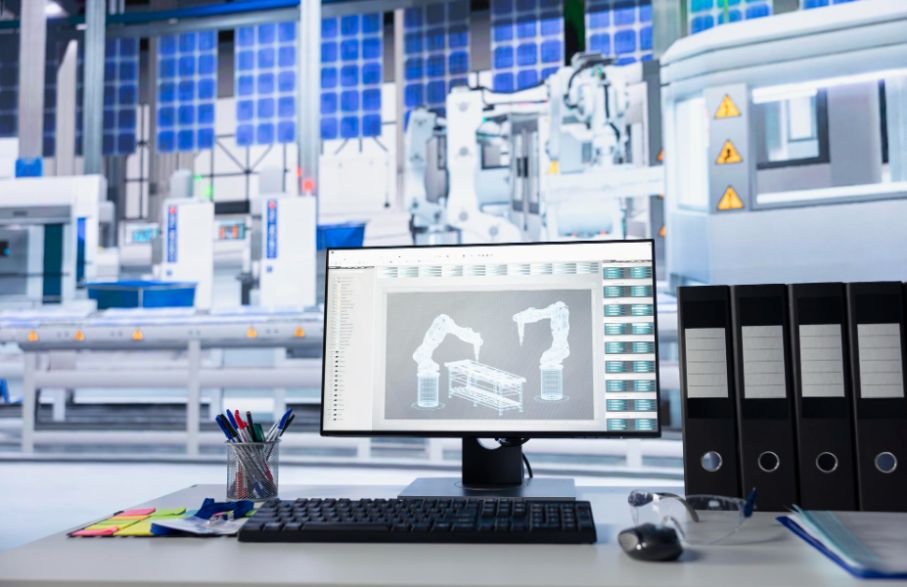
A traditional CNC machine normally performs a limited type of movement within a fixed working area. A six-axis industrial robot offers greater flexibility because its arm can approach a material from multiple directions. By changing its end effector, the same robot may cut, mill, drill, weld, print, place or inspect components.
The robot does not independently invent a building. Architects, engineers and fabricators establish the geometry, materials, toolpaths, tolerances and fabrication sequence. The machine then executes those instructions with controlled, repeatable movement.
How the Digital-to-Physical Workflow Works
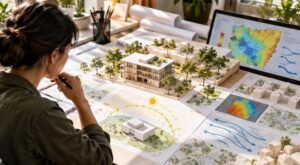
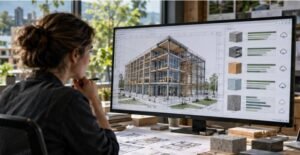
A robotic fabrication project usually begins with a computational or parametric model. Unlike a static drawing, a parametric model contains relationships between dimensions, materials and performance requirements.
Designers convert the model into robot movements through toolpath-planning software. Before fabrication begins, the team simulates the process to identify collisions, unreachable positions, excessive joint rotations and unsafe movements.
The physical setup must then be calibrated. The robot needs to understand the exact location of the workpiece, fabrication tool and surrounding equipment. Even a carefully prepared digital model can produce inaccurate results when the material is positioned incorrectly or the tool is poorly calibrated.
During fabrication, cameras, force sensors or scanning systems may collect feedback. This information allows the workflow to identify deviations and, in advanced applications, adjust robot movements rather than blindly repeating the original program.
Major Robotic Fabrication Methods
Additive Fabrication
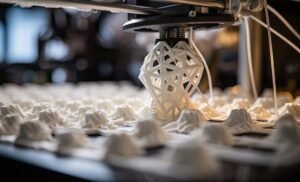
Additive processes create components by depositing material in layers or along calculated paths. Large robotic arms can extrude concrete, clay, polymers and composite mixtures.
Using digital fabrication with recycled materials can transform recovered polymers, mineral waste and composite offcuts into customized architectural components with carefully controlled geometries.
This approach reduces dependence on conventional formwork and supports curved or customized geometries. However, printing an entire building remains more complicated than printing its walls. Reinforcement, insulation, electrical systems, plumbing, openings and finishes still require coordinated construction processes.
Subtractive Fabrication
Subtractive fabrication removes material through milling, sawing, drilling, carving or hot-wire cutting. Robots can process timber, foam, stone and other materials from several angles, allowing them to create nonstandard joints and complex surface profiles.
The principal challenge is balancing geometric freedom with material waste, tool wear and fabrication time.
Forming, Bending and Winding
Robots can bend metal rods, form sheet materials or wind fibers around temporary supports. Fiber-winding systems are particularly valuable for lightweight structures because material can be placed according to structural forces rather than distributed uniformly.
These processes demonstrate how robotic tools can influence both the appearance and performance of architecture.
Assembly and Joining
Robots can position bricks, connect timber members, weld metal parts and assemble customized components. Assembly robots are especially useful when every element has a different orientation or connection detail.
Instead of repeating one identical action, the robot follows a sequence generated from the unique geometry of the project.
Materials Used in Robotic Construction
Timber is one of the most promising materials because robots can cut precise joints, drill connection points and position irregular members. This capability may also support reclaimed wood reuse by helping designers work with pieces that have different lengths and profiles.
Using computational design for material reuse allows robotic systems to analyse reclaimed components, adapt fabrication paths to their individual dimensions and integrate irregular materials into precise architectural assemblies.
Concrete remains central to large-scale additive manufacturing and robotic formwork research. Metal can be welded, bent or deposited to produce intricate structural elements. Clay supports customized masonry and ceramic systems, while polymers and composites are commonly used for lightweight shells, molds and prototypes.
Brick and stone can also be robotically placed or carved. The best material is not determined by the robot alone. It depends on structural requirements, local availability, fire performance, environmental impact and the ability to repair or reuse the final system.
Important Architectural Applications

Robotic fabrication can produce complex timber roofs, customized wall systems, free-form concrete elements, lightweight composite structures and individually shaped façade panels.
Research projects such as DFAB HOUSE have demonstrated how several digital building methods can be coordinated within one inhabited structure. Other experiments have used mobile robots for onsite brickwork and mesh systems that combine reinforcement with formwork for concrete.
Robotic laboratories also allow full-scale prototypes to be manufactured, tested and refined before a method reaches commercial construction. This testing is important because a visually impressive prototype does not automatically become a code-compliant, economical building system.
Benefits for Architects and Builders
The greatest advantage is not simply faster production. It is the ability to connect design decisions with material and manufacturing information.
Robotic systems can repeatedly execute complex movements, produce customized components without creating a separate mold for every variation and reduce errors caused by inconsistent manual positioning. They may also keep workers away from hazardous cutting, lifting or repetitive operations.
Material can be placed only where it contributes to structural, environmental or visual performance. This can reduce unnecessary material use, although sustainability depends on the complete lifecycle rather than automation alone.
Challenges That Cannot Be Ignored
Robotic equipment requires substantial investment in machines, tools, software, training and safety infrastructure. A company must also account for programming time, maintenance, calibration and prototype failures.
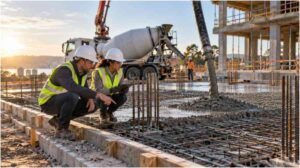
Industrial robots usually work best in controlled environments. Construction sites introduce dust, weather, uneven ground, moving workers and changing material conditions. Mobile robotic platforms must solve localization, stability and power-supply challenges before performing reliable onsite work.
Robot reach, payload and tool orientation also limit what can be manufactured. Building regulations may create further barriers when a new process lacks standardized testing or established approval procedures.
Frequently Asked Questions
1. What is robotic fabrication in architecture?
It is the use of programmable robotic systems to cut, shape, print, assemble or position architectural materials according to digital design information.
2. Is robotic fabrication the same as 3D printing?
No. Robotic 3D printing is one method. Architectural robots can also mill, drill, weld, bend, wind fibers, place bricks and assemble building components.
3. Which robots are commonly used?
Six-axis industrial robotic arms are widely used because they provide flexible movement and can operate with different end effectors. Mobile robots and collaborative systems are also being developed.
4. Can robots construct complete buildings?
Robots can produce important components and perform selected site operations, but most projects still require conventional trades, human supervision and coordinated installation.
5. Will robots replace construction workers?
They are more likely to change construction roles than remove people entirely. Workers will remain essential for planning, setup, inspection, installation, problem-solving and safety management.
A New Chapter for Architectural Making
I see robotic fabrication in architecture as more than a faster production method. Its real value lies in connecting computational design, material intelligence and physical construction through one coordinated workflow.
The technology still faces cost, regulation, safety and scalability barriers. Yet its progress suggests that future buildings will not simply be designed digitally and constructed conventionally. They will increasingly emerge from an ongoing conversation between designers, machines, materials and skilled makers.