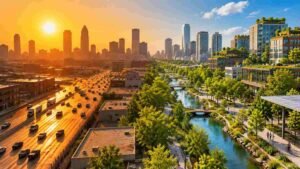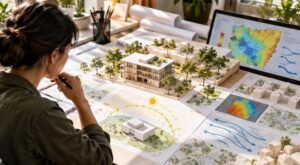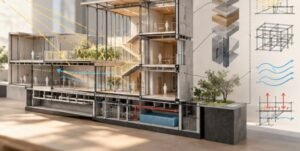
A park can do far more than provide shade, trails, and open space. In cities across the United States, public landscapes are being redesigned to hold stormwater, cool overheated neighborhoods, buffer coastal flooding, and recover faster after extreme weather.
That is why climate-resilient public space case studies are becoming increasingly important for architects, planners, and local governments. They show how everyday civic spaces can double as working climate infrastructure without losing their social or recreational value.
I find the most successful projects especially compelling because they do not treat resilience as a separate engineering layer. Instead, they weave flood control, heat mitigation, water management, habitat restoration, and community use into the same design. That creates public spaces that feel useful on an ordinary day and become even more valuable when climate conditions turn severe.
How Are US Parks Being Designed to Handle Urban Flooding?
Flooding presents one of the clearest opportunities to turn public space into working infrastructure. Instead of trying to keep water out at all costs, resilient landscape design gives excess water somewhere safe to go.
Buffalo Bayou Park, Houston, Texas
Houston’s 160-acre Buffalo Bayou Park demonstrates how flood-prone landscapes can remain valuable public amenities. Rather than treating periodic flooding as a design failure, the park works with the bayou’s natural conditions. Native landscaping, durable trails, stabilized slopes, and flood-tolerant landscape systems help the space recover after high-water events.
I find this approach especially relevant for American cities experiencing more intense rainfall. Designing landscapes that can flood, drain, recover, and reopen can be more practical than trying to prevent every flood event.
Green City, Clean Waters, Philadelphia, Pennsylvania
Philadelphia has taken the concept beyond an individual park. Green City, Clean Waters is a 25-year program that uses green stormwater infrastructure across streets, parks, schools, and other public spaces to reduce the amount of runoff entering the city’s combined sewer system.
Rain gardens, plants, soil, stone, and other decentralized systems capture rainfall where it lands and release it more slowly. By 2026, Philadelphia reported thousands of green stormwater systems and billions of gallons of polluted stormwater prevented from reaching waterways each year.
For US planners, the lesson is important: resilience does not always require one enormous engineering project. A network of smaller interventions can reshape an entire watershed.
Thornton Creek Water Quality Channel, Seattle, Washington
Seattle’s Thornton Creek project demonstrates how stormwater treatment can become visible public landscape infrastructure. The redevelopment replaced heavily impervious conditions with an open channel and planted landscape designed to slow and filter runoff.
Instead of sending polluted roadway runoff directly through pipes, the landscape uses vegetation and natural processes to improve water quality while creating a more attractive pedestrian environment. The broader idea is simple but powerful: drainage infrastructure can also become habitat and usable urban space.
How Can Waterfront Parks Protect Cities From Sea-Level Rise?
Coastal communities face a different challenge. Storm surge and rising seas require public waterfronts to function as protective buffers without cutting people off from the water.
Climate Ready East Boston, Massachusetts
Boston’s climate-resilience planning shows how waterfront parks, elevated landscapes, berms, flood barriers, and redesigned public routes can help protect low-lying neighborhoods.
What makes this strategy effective is integration. Instead of constructing defensive infrastructure as an isolated wall, cities can incorporate flood protection into parks, plazas, pathways, and waterfront improvements.
That approach preserves everyday recreational value while creating additional protection when coastal flooding occurs.
Hunter’s Point South Waterfront Park, Queens, New York

Hunter’s Point South offers another useful model for waterfront climate adaptation. Its landscape combines public access with wetlands, resilient planting, and varied shoreline topography.
Tidal landscapes can slow water, absorb wave energy, create habitat, and give stormwater room to move rather than forcing every edge into a rigid seawall.
For coastal US cities, that represents a broader transition from fighting water toward designing landscapes that accommodate it safely.
How Are Public Spaces Helping Cities Reduce Extreme Heat?
Flood resilience receives significant attention, but extreme heat can be equally dangerous. Asphalt, concrete, limited tree canopy, and dense development can push urban temperatures far above surrounding areas.
Underwood Family Sonoran Landscape Laboratory, Tucson, Arizona
The University of Arizona’s Underwood Family Sonoran Landscape Laboratory transformed 1.2 acres of former parking area into a high-performance desert landscape. It demonstrates water harvesting, water reuse, microclimate mitigation, runoff management, and native habitat creation.
The project includes an 18,000-gallon desert wetland and approximately 10,500 gallons of retention capacity in its lower patio while using desert-adapted landscape strategies.
I think this project offers an especially useful lesson for Phoenix, Las Vegas, Albuquerque, and other hot US cities: urban cooling does not need to depend on water-intensive landscaping. Native vegetation, shade, water harvesting, and careful site design can create more comfortable microclimates while respecting arid conditions.
Sapwi Trails Community Park, Thousand Oaks, California
In drought- and wildfire-prone regions, resilience requires another layer of thinking. Large public landscapes can support recreation while preserving watersheds, reducing excessive fuel loads, and using vegetation better suited to dry regional conditions.
Projects such as Sapwi Trails highlight the importance of considering heat, drought, wildfire risk, ecological health, and public access together rather than addressing each challenge separately.
What Do Successful Climate-Resilient Public Spaces Have in Common?

When I compare these climate-resilient public space case studies, one pattern stands out: successful projects rarely perform a single function.
Floodable parks still provide trails and recreation. Green stormwater systems improve neighborhoods while managing runoff. Coastal landscapes provide habitat while reducing exposure to surge. Desert landscapes conserve water while improving pedestrian comfort.
This multifunctional approach is one reason nature-based solutions have become so important in climate adaptation. Bioswales, rain gardens, wetlands, native plants, permeable paving, tree canopy, and restored waterways can deliver environmental and community benefits simultaneously.
They can also support climate justice when investments reach neighborhoods that historically lack high-quality parks, tree canopy, and modern stormwater infrastructure.
Frequently Asked Questions (FAQs)
1. What makes a public space climate resilient?
A climate-resilient public space is designed to withstand or reduce hazards such as flooding, extreme heat, storm surge, drought, and heavy rainfall while continuing to provide social, recreational, ecological, or transportation benefits.
2. Which US cities are leading in resilient public-space design?
Houston, Philadelphia, Seattle, Boston, New York, Tucson, and several California communities provide strong examples of public spaces that incorporate flood management, coastal resilience, water conservation, and urban heat mitigation.
3. How do parks help reduce urban flooding?
Parks can capture and temporarily store rainfall through rain gardens, bioswales, permeable surfaces, wetlands, detention areas, floodable lawns, and planted channels. These features reduce peak runoff entering conventional drainage systems.
4. What is green stormwater infrastructure?
Green stormwater infrastructure uses vegetation, soils, stone, permeable materials, and landscape systems to capture, infiltrate, filter, or slow stormwater close to where rainfall occurs.
5. Why are nature-based solutions important in US cities?
Nature-based solutions can address climate risks while also improving biodiversity, shade, air quality, recreation, habitat, and neighborhood livability. This allows one public investment to provide several long-term benefits.
What Can US Cities Learn From These Projects?
The strongest climate-resilient public space case studies suggest that American cities should stop treating climate infrastructure and public space as separate investments.
Designers should begin with the local hazard. Houston requires flood-tolerant landscapes. Boston needs coastal protection. Tucson must address heat and water scarcity. Philadelphia must reduce pressure on an aging combined sewer system.
From there, planners can create spaces that respond to those risks while remaining useful every day. Similar lessons can be seen in adaptive reuse case studies in small cities, where successful projects also depend on responding to local conditions while giving existing places a durable new role.
I believe that is the central lesson for the next generation of American public-space design: resilience works best when infrastructure becomes part of ordinary community life.