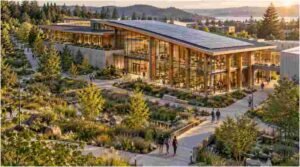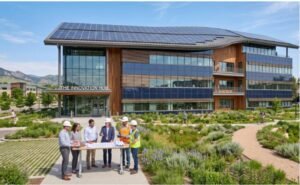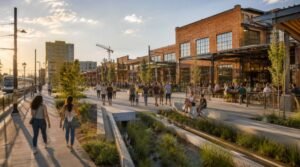
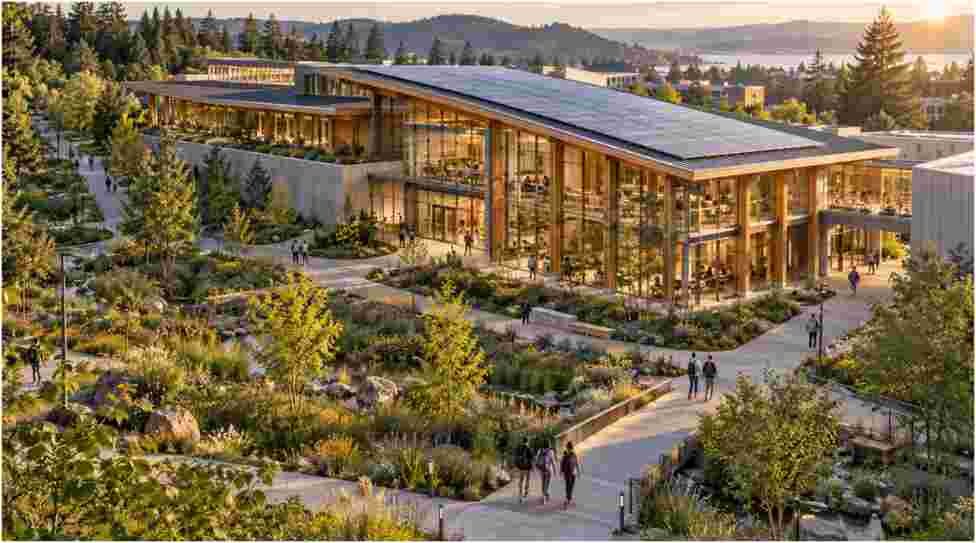
Most green institutional architecture aims for a neutral footprint. I spent years managing campus facility master plans under that standard, yet neutral merely slows degradation. True ecological restoration begins when we implement regenerative design frameworks for institutional buildings—moving past standard efficiency toward facilities that actively clean local watersheds, generate surplus energy, and rebuild native habitats.
Campuses, civic centers, and healthcare facilities occupy land across multi-decade spans. When institutions treat their capital projects as living ecological anchors, buildings stop consuming community assets and begin generating tangible biological and economic returns.
Shifting Campus Architecture from Harm Reduction to Ecological Co-Evolution
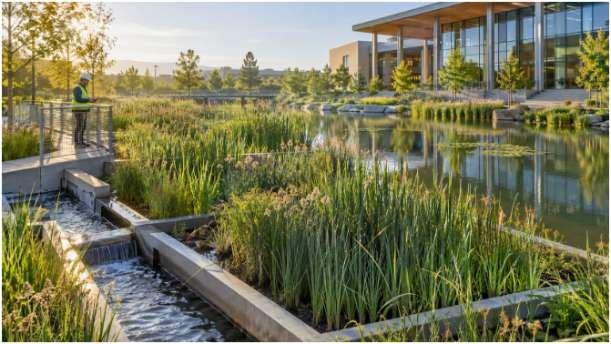
Conventional green building practice measures success by what it avoids. It tracks carbon emissions not emitted, gallons of potable water conserved, and landfill waste diverted. That harm-reduction mindset leaves us with structures that damage our environment less rapidly than code-minimum buildings.
Regenerative architecture turns this baseline upside down. A regenerative structure operates like an indigenous organism within its watershed. It sequesters more carbon than its construction released, outputs clean water back into local aquifers, and supports surrounding human communities.
Why Institutional Assets Outperform Speculative Developments in Circularity
Commercial real estate typically operates on a seven-to-ten-year exit horizon. That compressed window penalizes forward-looking capital expenditures on complex living wastewater machines, deep thermal borefields, or high-performance envelope assemblies.
Institutional clients hold their buildings for fifty to one hundred years. A university, civic health system, or municipal government acts as its own long-term utility provider. When an institutional building produces 105% of its power, the owner captures the full operational savings across half a century.
Furthermore, institutions carry mission-driven charters. A municipal center or teaching hospital must protect community health and long-term public welfare. This charter creates an institutional runway where regenerative capital investments align directly with organizational survival.
Evaluating the Core Frameworks: LBC, LENSES, and AIA Design Excellence
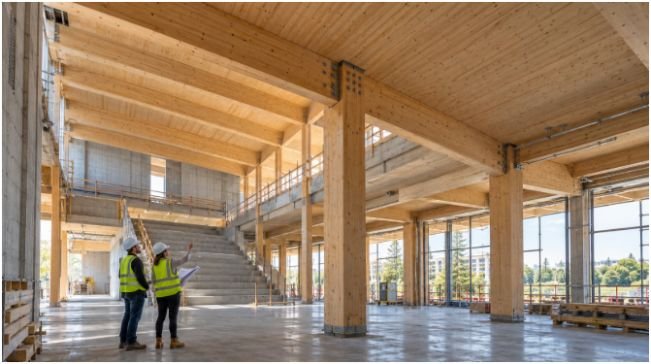
Selecting a design system determines how consultants, contractors, and stakeholders coordinate decisions. Three primary systems currently guide regenerative work across institutional campuses.
[ Regenerative Ambition ]
▲
│ ★ Living Building Challenge (LBC)
│ • 105% Net-Positive Energy & Water
│ • Red List chemical elimination
│ • 12-month post-occupancy audit
│
│ ◆ LENSES Framework
│ • Systemic relational mapping
│ • Multi-stakeholder alignment
│
│ ● AIA Framework for Design Excellence
│ • 10 holistic design measures
│ • Broad industry adoption
│
▼
[ Baseline Harm Reduction ]
Living Building Challenge: The 12-Month Audited Reality
The International Living Future Institute created the Living Building Challenge (LBC) as the most uncompromising regenerative benchmark in architecture. Unlike standards that rely on computer-simulated design models, LBC requires twelve consecutive months of verified operational data before awarding full certification.
LBC organizes performance across seven Petals: Place, Water, Energy, Health & Happiness, Materials, Equity, and Beauty. Full Living certification requires compliance with all twenty underlying Imperatives.
The standard enforces a non-negotiable Net Positive Water mandate and a Net Positive Energy rule that forbids combustion appliances. While a conventional net zero energy building balances power inputs and outputs mathematically across twelve months, LBC demands 105% on-site production paired with localized resilience. Its rigorous Materials Petal bans hundreds of toxic substances on the Red List, demanding supply chain transparency down to 100 parts per million.
LENSES: Visualizing Complex Governance and Systemic Flows
The LENSES (Living Environments in Natural, Social, and Economic Systems) framework takes a process-driven approach rather than enforcing fixed metrics. It relies on a visual matrix that maps relationships across eleven critical flows, including hydrology, soil health, culture, financial capital, and governance.
Institutional campus projects often stall because facilities teams, academic deans, municipal officials, and local neighbors hold conflicting priorities. LENSES excels during early master planning by engaging these diverse groups. It guides non-technical stakeholders to identify regional ecosystem vulnerabilities and co-create holistic project goals.
AIA Framework for Design Excellence: Scaling Regional Stewardship
The AIA Framework for Design Excellence translates broad regenerative philosophies into practical design workflows. Organized around ten measures—ranging from Design for Ecosystems and Design for Water to Design for Well-Being and Design for Change—it functions cleanly across varying institutional procurement models.
This system provides institutional boards with accessible milestones. Teams that cannot manage the financial premiums or supply-chain audits of full LBC compliance can still address regional ecology, embodied carbon, and community equity using the AIA structure. Many campus architects treat it as an approachable gateway toward regenerative performance.
Practical Engineering: Closed-Loop Water and Embodied Carbon Strategies
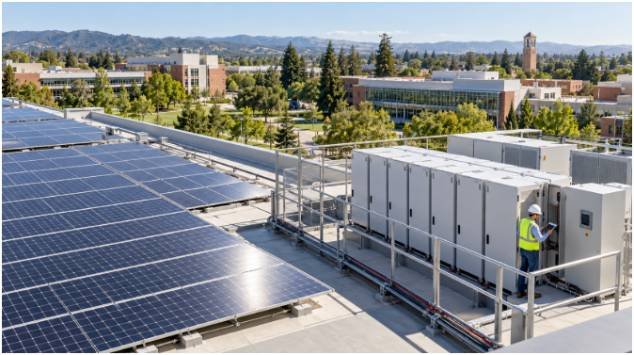
Moving from theoretical frameworks to built infrastructure requires solving two technical challenges: localized water recycling and upfront material carbon.
Treating On-Site Blackwater Without Regulatory Deadlocks
Achieving closed-loop hydrology requires institutional sites to collect precipitation and treat all generated greywater and blackwater on-site. In practice, this means integrating subsurface constructed wetlands, tidal-flow marshlands, or aerobic membrane bioreactors.
Institutional Hydrologic Loop:
[Precipitation] ──► [Rainwater Cisterns] ──► [Potable Treatment] ──► [Campus Use]
│
▼
[Subsurface Wetlands] ◄── [Bio-Filtration] ◄── [Blackwater & Greywater]
│
▼
[Aquifer Recharge / Toilet Flushing]
Municipal building departments often lack codes covering on-site blackwater treatment for commercial facilities. During project delivery, design teams must approach local water authorities early during schematic design. I recommend presenting empirical effluent water-quality data from operational facilities like the Phipps Center for Sustainable Landscapes.
Securing a variance requires designing secondary containment, fail-safe UV disinfection, and real-time turbidity telemetry. Once operational, these systems eliminate municipal sewer charges and supply constant irrigation and flush-water supplies.
Navigating Mass Timber and Structural Spec Overhauls
Concrete foundations and steel superstructure frames generate the majority of an institutional building’s embodied carbon footprint. Achieving regenerative material benchmarks requires restructuring master structural specifications.
Teams should prioritize mass timber systems, including cross-laminated timber (CLT) and glue-laminated columns harvested from sustainably managed forests. Mass timber stores atmospheric carbon throughout the structure’s physical life.
For below-grade foundations, structural teams should specify low carbon alternative cements that replace high-emission Portland cement with supplementary cementitious materials, calcined clays, or bio-consolidated minerals. Pairing structural timber with non-toxic interior finishes eliminates common off-gassing hazards and supports healthier indoor learning spaces.
The Financial Reality: 60-Year Life Cycle Cost Analysis Over 5-Year Paybacks

The financial objection to regenerative institutional architecture always centers on upfront capital costs. Fully certified Living buildings carry an upfront cost premium between 10% and 22% over regional code baselines. Sourcing certified Red List-free materials, engineering on-site blackwater filtration, and installing battery microgrids require higher upfront capital.
Evaluating these facilities through a standard three-to-five-year commercial payback window makes little financial sense. Institutions must run life-cycle cost analyses (LCCA) across a 50-to-60-year operating horizon.
Long-Term Financial Trajectory:
$ ─── Conventional Institutional (Low upfront CapEx, compounding OpEx & utility risks)
$ ─── Regenerative Campus Asset (Higher initial CapEx, stable flat-line operating costs)
Across multiple decades, utility costs, stormwater utility assessments, and municipal water prices escalate predictably. A regenerative campus building insulates institutional operating budgets from these price spikes.
When regional municipal power grids fail during extreme weather events, an islandable regenerative microgrid maintains campus operations and preserves sensitive biomedical research. That operational continuity protects millions of dollars in research funding and ensures public safety, providing financial returns that dwarf initial construction premiums.
Frequently Asked Questions About Institutional Regenerative Design
1. How does regenerative design differ fundamentally from standard LEED certification?
Standard LEED v4.1 focuses on efficiency baselines and modeled performance, whereas regenerative frameworks mandate audited net-positive ecological generation.
2. What is the typical capital cost premium for a Living Building Challenge institutional project?
Institutional projects historically average an upfront capital cost premium between 10% and 22%, driven primarily by on-site water systems, microgrids, and material vetting.
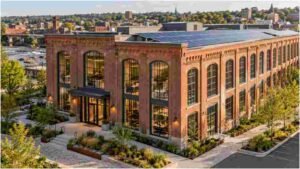
3. Can historical institutional buildings achieve regenerative certification?
Yes, historic campus retrofits frequently achieve petal certifications by optimizing existing building envelopes, eliminating toxic interior finishes, and tying into campus district energy networks.
4. What is the biggest regulatory barrier to regenerative institutional architecture?
Local health department codes regarding on-site blackwater filtration and rainwater potable reuse present the most persistent permitting challenges.
Stop Patching Bad Systems: Build Ones That Heal
Continuing to build code-minimum institutional facilities is an expensive long-term liability. Every building that drains public water supplies, leaks fossil-fuel heat, and off-gasses synthetic chemicals increases long-term campus maintenance and municipal risk.
If your institution is preparing a capital campaign or drafting an updated master plan, remove conventional net-zero minimums from your architectural RFP. Demand regenerative performance benchmarks that heal your local watershed and stabilize your operating budgets for the next century.
Start by auditing your regional ecological priorities, convene your campus stakeholders under the LENSES or AIA frameworks, and design buildings that actively restore the communities they serve.