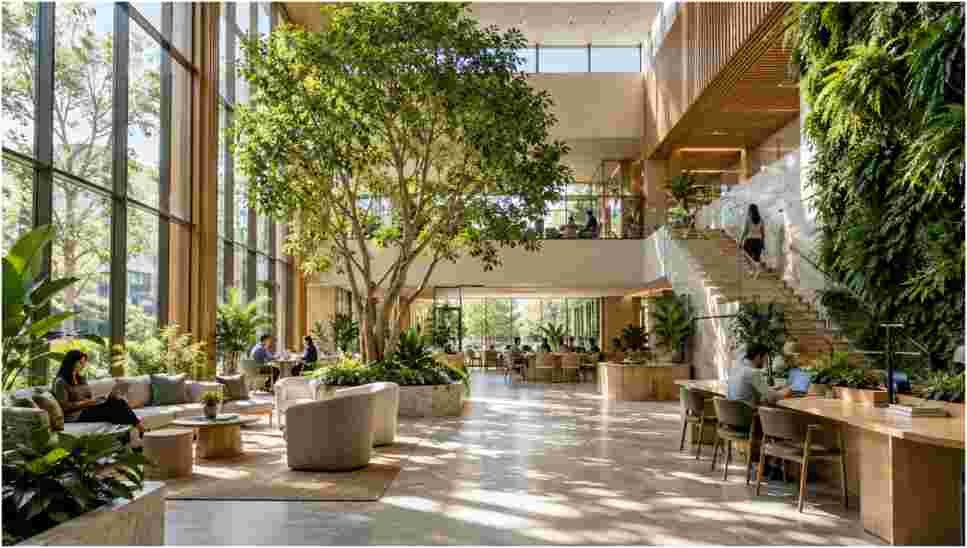
Most daylight models treat indoor space like an empty drywall cube. When I run a biophilic interior architecture daylighting simulation, I discard conventional horizontal workplanes to evaluate how light fuels both human endocrine systems and living vegetation.
Standard compliance metrics check regulatory boxes, but they fail to predict whether a two-story fiddle-leaf fig tree will drop its foliage or whether an occupant will experience afternoon headaches from veiled glare.
| Stage | Occupant Circadian Analysis | Botanical Light Analysis |
| Shared baseline | Climate & geometry baseline (EPW) | Climate & geometry baseline (EPW) |
| Analysis grid | Occupant circadian grid | Botanical mesh grid |
| Grid location | Eye level: 1.2 m / 1.7 m above finished floor (AFF) | Vertical living wall & planters |
| Grid orientation | Horizontal view vectors | Outward surface normals |
| Light metric | Equivalent Melanopic Lux (EML) | Photosynthetic Photon Flux Density (PPFD) |
| Target | ≥200 EML | 50–150 µmol/m²/s |
| Combined design outcome | Balanced biophilic design: no glare and vibrant living assets | Balanced biophilic design: no glare and vibrant living assets |
Natural daylight shifts across the sky every minute. It scatters through timber slats, bounces off honed stone, and filters through biological leaves. Capturing those dynamics demands computational rigor, precise spectral conversions, and an eye for biological function.
The Breakdown of Static Foot-Candle Calculations
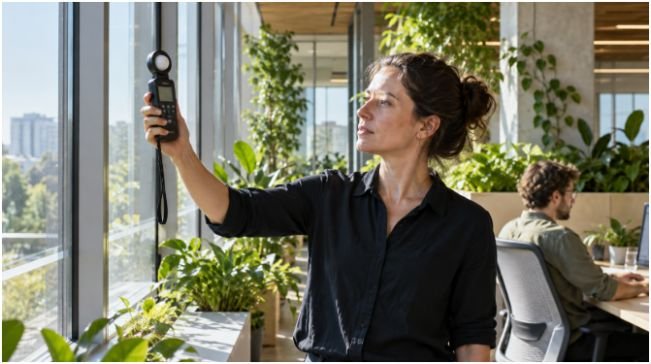
Relying on uniform foot-candle averages creates sterile interiors. Early in my design practice, I reviewed spaces that met commercial illumination codes yet felt lifeless and cavernous. Real daylight varies continuously across time, orientation, and sky conditions. Modern biophilic analysis relies on climate-based daylight modeling (CBDM), incorporating historical weather datasets validated through the National Institute of Building Sciences to evaluate seasonal performance.
Spatial Daylight Autonomy and Glare Boundaries
Spatial Daylight Autonomy (sDA) measures the percentage of an interior floor plate that receives at least 300 lux of natural light for a minimum of 50% of annual operating hours. In biophilic design, I target $\text{sDA}_{300/50\%} \ge 75\%$.
High daylight autonomy without glare protection ruins spaces. Direct solar beams cause visual fatigue, screen washout, and unwanted internal thermal gains that undermine thermal envelope optimization passive solar design.
To prevent this, I pair sDA against Annual Sunlight Exposure (ASE). The standard metric, ASE1000,250, flags points receiving direct solar radiation above 1,000 lux for more than 250 hours per year. Keeping ASE below 10% ensures daylight enters through filtered, low-contrast paths rather than harsh, blinding shafts.
Circadian Stimulus and Vertical Eye-Level Retinal Plane
Humans process light through intrinsically photosensitive retinal ganglion cells (ipRGCs). These cells do not look down at desks. They point forward, absorbing light from vertical visual fields to regulate melatonin secretion and alertness.
The International WELL Building Institute codifies this through Equivalent Melanopic Lux (EML). To hit the standard target of 200EML between 9:00 AM and 1:00 PM, I evaluate vertical eye-level planes rather than horizontal floors. Under natural CIE Standard Illuminant D65 daylight, the photopic-to-melanopic conversion ratio (Rmel) hovers near 1.10:
EML=VerticalPhotopicLux1.10
Designing for this threshold demands placing morning workstations within direct visual contact of high-angle apertures and clerestory glazing.
Integrating Botanical Photobiology with Human Comfort
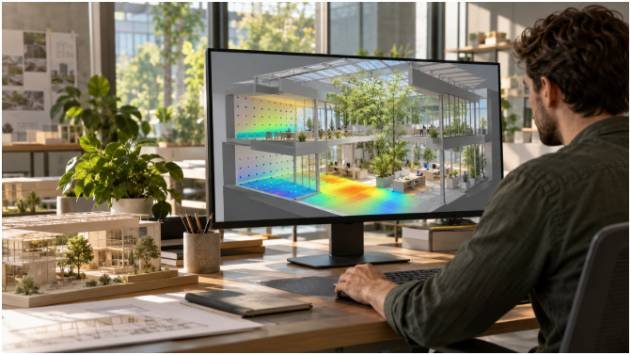
Biophilic architecture incorporates living organisms into structural envelopes. Adding an expansive indoor green wall sounds straightforward until foliage withers under weak, indirect light. Plants register light differently than human eyes. While human eyes peak in sensitivity around green wavelengths (555 nm), plant chlorophyll absorbs blue (430–450 nm) and red (640–660 nm) photon bands.
Translating Photopic Lux to Plant Photon Flux Density
Standard architectural ray tracers compute photopic illuminance in lux. Horticultural analysis requires Photosynthetically Active Radiation (PAR) quantified as Photosynthetic Photon Flux Density (PPFD), measured in $\mu\text{mol/m}^2/\text{s}$.
When converting simulated daylight lux to botanical PPFD, I use an empirical daylight conversion factor:
| Interior Flora Species | Target PPFD (µmol/m²/s) | Daily Light Integral (mol/m²/day) |
| Understory Ferns & Pothos | 30–60 | 3–5 |
| Ficus & Schefflera Canopies | 80–140 | 8–12 |
| Flowering Biophilic Assets | 150–250+ | 14–18+ |
For shade-tolerant interior foliage like Monstera deliciosa or Epipremnum aureum, I verify that our apertures deliver sustained levels between $50\text{ and }100\ \mu\text{mol/m}^2/\text{s}$. Over a ten-hour day, this satisfies the plant’s Daily Light Integral (DLI) without demanding full-spectrum electric grow lights.
Bidirectional Scattering and Dynamic Foliage Canopies
Standard modeling programs treat vegetation as solid polygons. In reality, a tree canopy functions as a complex, translucent scattering filter.
To simulate the natural phenomenon of komorebi—dappled sunlight filtering through woodland canopies—I assign Bidirectional Scattering Distribution Function (BSDF) data to organic materials. This technique measures front-side diffuse reflectance, back-side transmittance, and direct micro-perforations through leaf layers. Integrating measured BSDF files gives our simulations the ability to show how internal trees soften solar heat gain while projecting organic shadow patterns across floor surfaces.
My Honeybee and Radiance Dual-Grid Simulation Setup
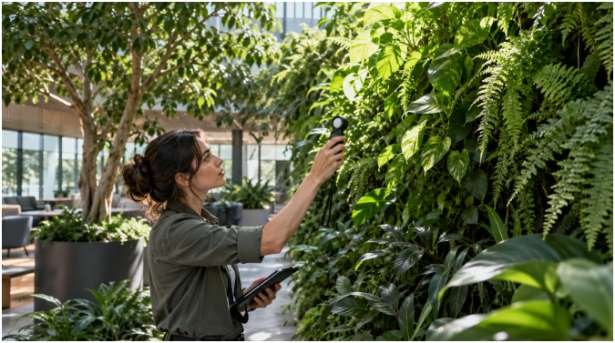
To execute a dependable biophilic simulation, I combine Rhino, Grasshopper, Ladybug, and Honeybee to drive the Radiance simulation core. Developed by the Lawrence Berkeley National Laboratory, Radiance remains the gold standard for physically accurate backward ray tracing.
Modeling Complex Enclosures and Apertures
I start by building accurate geometric envelopes in Rhino. I export EnergyPlus weather data using EPW files sourced from the U.S. Department of Energy to capture regional sky conditions, solar azimuths, and direct-to-diffuse radiation splits.
Every wall surface receives calibrated reflectance properties. White acoustic ceilings receive an 80% diffuse reflectance finish, internal partition walls sit at 50%, and raw concrete or timber finishes average 25% to 35%. I explicitly model exterior shading louvers, overhangs, and light shelves. These passive shading devices bounce high-angle summer rays onto reflective ceilings while permitting low winter sun to penetrate deep into interior zones, an approach that forms the core of modern sustainable construction.
Splitting the Sensor Meshes
My Grasshopper canvas uses two parallel sensor grids:
Rhino Architecture
│
▼
Honeybee HB Model ─────────► Radiance Engine (-ab 6 -ad 4096 -aa 0.08)
│ │
├─────────────────┬───────────────────┤
▼ ▼ ▼
Occupant Grid Living Wall Grid Illuminance Arrays
(1.2m Eyes) (Foliage Normals) │
│ │ │
▼ ▼ ▼
Melanopic Math Photobiology Math Visual Comfort & ASE
(EML >= 200) (PPFD 50-150) (ASE <= 10%)
- The Human Circadian Grid: I generate points at 1.2m above finished floor for seated areas and 1.7m for standing corridors. Instead of pointing vectors up toward the ceiling, I orient them horizontally along dominant occupant view vectors.
- The Living Wall Mesh Grid: I subdivide vertical surfaces and planting beds into a 0.25m0.25m quad mesh. Using surface evaluation components, I extract normal vectors directed outward into the room space.
With my Radiance ambient parameters set to -ab 6, -ad 4096, and -aa 0.08, the engine resolves inter-reflections through glass, wood louvers, and interior finishes. The simulation outputs photopic lux for the occupant grid and spectral irradiance for the living wall grid, enabling parallel evaluation of circadian health and plant viability.
Failure Checkpoints I Encounter in Real Projects
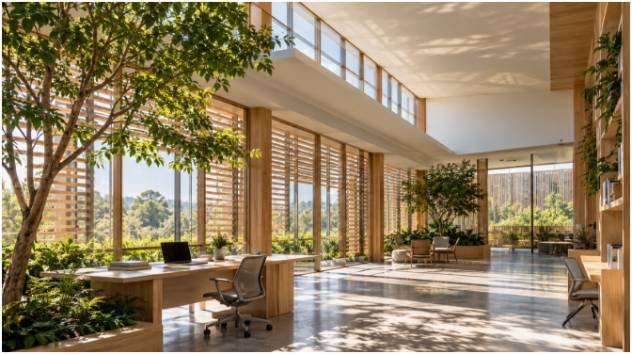
When reviewing daylighting calculations, watch out for these recurring failure modes:
- The High-Autonomy Burnout: An office achieves an impressive 88% sDA, but ASE reaches 24%. Occupants close blinds by 10:00 AM, flip on electric lights, and cancel out the natural daylighting design.
- The Living Wall Starvation Pocket: A living wall placed five meters from south-facing windows drops below $20\ \mu\text{mol/m}^2/\text{s}$ at lower tiers. Upper leaves flourish while the lower third drops foliage within months, requiring supplemental track-mounted horticultural lighting.
- The Monochromatic Glazing Trap: Low-e coatings with low Visible Light Transmittance (VLT below 40%) distort incoming color spectrums. This limits the blue wavelengths needed for ipRGC stimulation and photosynthetic activity.
Stop Designing for Average Light
Daylight simulation should never reduce natural illumination to an average value on an empty floor. True biophilic architecture honors natural rhythms: it energizes human biology during morning hours, shields eyes from harsh afternoon glare, and gives interior plant life the specific light spectrum it needs to grow.
Before finalizing your next interior model, separate your sensor grids, orient your analysis vectors toward biological surfaces, and let natural daylight do its intended work.
Frequently Asked Questions
1. What is the difference between sDA and ASE in biophilic design?
sDA calculates the sufficiency of natural daylight across occupied hours, while ASE identifies excessive, glare-inducing direct sunlight.
2. How does daylighting simulation ensure indoor plants survive?
Simulations convert radiant daylight into Photosynthetic Photon Flux Density to confirm that foliage receives sufficient light energy for healthy growth.
3. Why are vertical sensor grids required for circadian EML analysis?
The human eye contains photoreceptors that process light entering horizontally across retinal paths rather than downward from ceilings.
4. Which simulation tools best handle biophilic daylight modeling?
Rhino paired with Grasshopper, Honeybee, Ladybug, and the Radiance engine delivers the flexibility required for custom non-coplanar biophilic sensors.